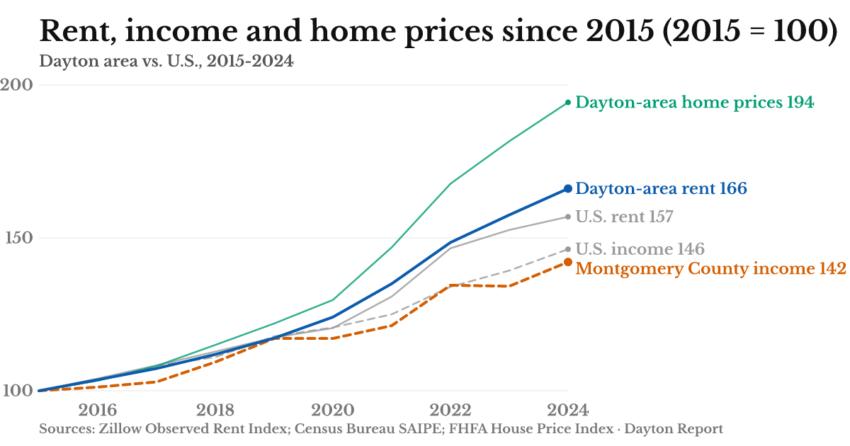
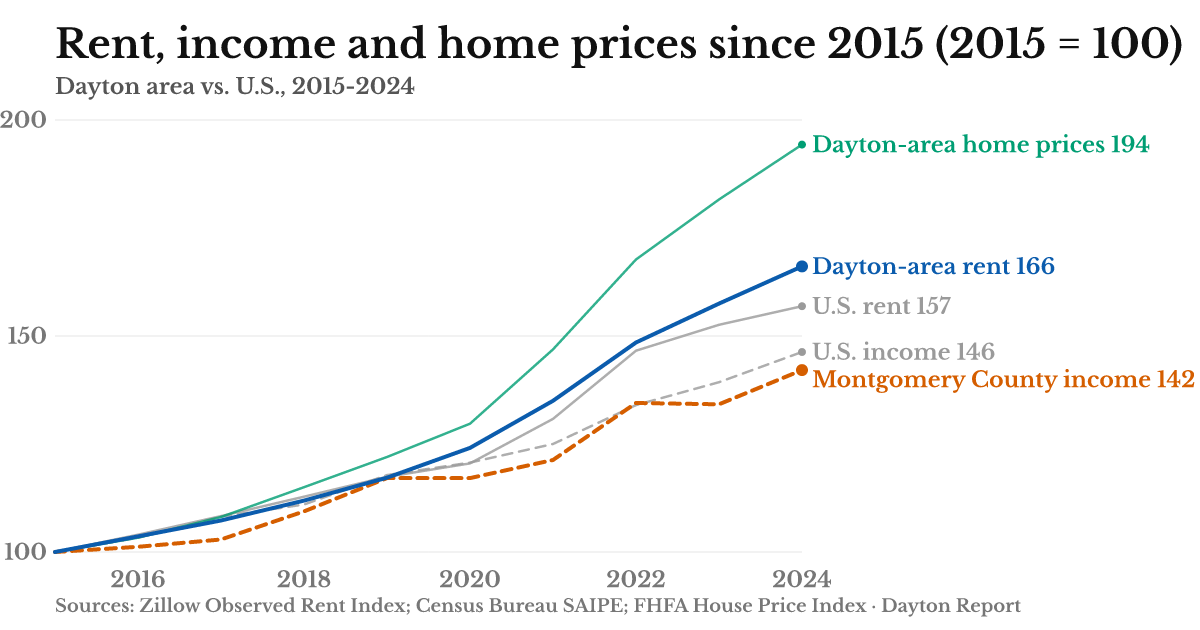
Typical asking rent in the Dayton area rose 66.1% from 2015 to 2024, by the Zillow Observed Rent Index. Over the same years, Montgomery County’s median household income rose 42.1%, and rents across the U.S. rose 56.9%. Dayton is still one of the less expensive places to live in the country, but by these measures it became less affordable over the decade, and a little faster than the nation did.
Rent: up faster here than nationally
The typical asking rent in the Dayton metro area averaged $735 a month in 2015 and $1,222 in 2024. Nationally the figure went from $1,165 to $1,827. In dollars, the U.S. rise was bigger; in percentage terms, Dayton’s was, 66.1% against 56.9%. Typical Dayton-area rent was still about 33% below the national figure in 2024.
Zillow’s index measures what landlords ask of new tenants, which runs ahead of what people on existing leases pay. That makes it a good gauge of what someone moving here, or moving within the area, faces. Our rent page tracks it every month, with Columbus, Cincinnati, the U.S. and the Miami Valley cities Zillow covers.
Income: up, but not as fast
Montgomery County’s median household income was $46,696 in 2015 and $66,349 in 2024, the Census Bureau’s latest estimate: up 42.1%, against 46.3% for the U.S. median, which reached $81,604. Income gains here were real, but they trailed both local rents and national income growth.
Rent’s share of a typical income
Put rent and income together and the trend is clear. Twelve months of typical asking rent came to 18.9% of Montgomery County’s median household income in 2015 and 22.1% in 2024. For the U.S., the same measure went from 25.1% to 26.9%. The Dayton area remains below the national level, but the gap narrowed from 6.2 percentage points to 4.8.
Those shares use the median income of all households, owners and renters. Renters’ incomes are typically lower, so the share of income a typical renter pays is higher than these figures; the trend is the point.
Home prices: also up faster than the nation
For buyers the story is similar. The Federal Housing Finance Agency’s house price index for the Dayton metro rose 94.3% from 2015 to 2024, compared with 89.1% for the U.S. In our own MLS records, the median Miami Valley sale price was 2.8 times Montgomery County’s median household income in 2019 and 3.7 times in 2024.
Why it’s rising faster: a long climb back
The faster rise since 2015 comes after a long stretch when the Dayton area fell behind. The Dayton metro had about 424,000 nonfarm jobs in 2000 and about 361,000 at the low point after the recession, by Bureau of Labor Statistics figures; it had about 398,000 in 2025, still below 2000.
Home prices tell the same story. From 2000 to 2015, the FHFA index for the Dayton metro rose 6.7%, while the U.S. index rose 51.1%. Dayton-area prices didn’t get back above their 2006 level until 2018, a year after the nation’s. Over the whole stretch from 2000 to 2025, prices here rose 119.4% against 196.7% nationally: even after a decade of faster growth, the area is still behind where steady growth would have put it.
So part of the recent rise is a rebound from a low base, and it has come without closing the gap: rents and prices here remain below the national average.
What renters actually pay
Zillow measures asking rents. The Census Bureau’s American Community Survey measures what all renter households pay, including utilities. By that measure, the Dayton metro’s median gross rent was $748 in 2015 and $1,149 in 2025, up 53.6%; the U.S. median went from $959 to $1,557, up 62.4%. So asking rents here rose faster than the nation’s, while what renters actually pay rose more slowly.
The share of Dayton-area renters paying 30% or more of their income for housing, the federal definition of cost-burdened, was 46.9% in 2015 and 42.9% in 2025; nationally it was 50.6% and 51.8%. Renters paying half their income or more made up 19.1% of the area’s renters in 2025, against 26.2% nationally.
A third measure, HUD’s Fair Market Rent, sets the limits for Housing Choice Vouchers: for fiscal 2026, a two-bedroom in the Dayton metro is $1,273 a month, rent plus utilities, at the 40th percentile of recently rented units.
Prices overall: about the same gap as in 2015
The Bureau of Economic Analysis put the Dayton area’s overall price level at 92.6 in 2015 and 92.7 in 2024, on a scale where the U.S. is 100. Across everything people buy, a dollar goes about 7.9% further here than at average U.S. prices. Housing is where the advantage is largest, and housing costs are what rose fastest.
The assessment
Measured against its own past, the Dayton area is less affordable than it was in 2015: rents and home prices rose faster than incomes. Measured against the rest of the country, it is still more affordable than average, with lower rents, lower home prices and lower overall prices. Some of the faster rise is a recovery from a long slump after the 2000s, and even after a decade of above-average growth, prices here remain below the national average. Both things are true at once, and both matter to anyone deciding whether to move here or stay.
That raises a question for the community: what would help keep housing within reach here, whether that’s building more homes, raising wages, or something else?
About these numbers
Rent: Zillow Observed Rent Index, all homes plus multifamily, smoothed, yearly averages of monthly figures, for the Dayton-Kettering-Beavercreek metro area and the U.S. Income: U.S. Census Bureau Small Area Income and Poverty Estimates, through the Federal Reserve Bank of St. Louis (FRED), for Montgomery County, Ohio and the U.S.; 2024 is the latest year published. Home prices: Federal Housing Finance Agency All-Transactions House Price Index, yearly averages, for the Dayton metro and the U.S. Overall prices: BEA Regional Price Parities. Fair Market Rents: U.S. Department of Housing and Urban Development, Fair Market Rents and Small Area Fair Market Rents, fiscal 2026. Figures aren’t adjusted for inflation. Rent data: Zillow Observed Rent Index (ZORI), Zillow Research.
Follow Dayton Report: Facebook · X
