West Dayton’s comeback has never been about one number. It’s about a record that keeps accumulating, sale after sale, until the pattern is impossible to argue with. But every so often a single transaction does more than confirm the trend — it moves the ceiling.
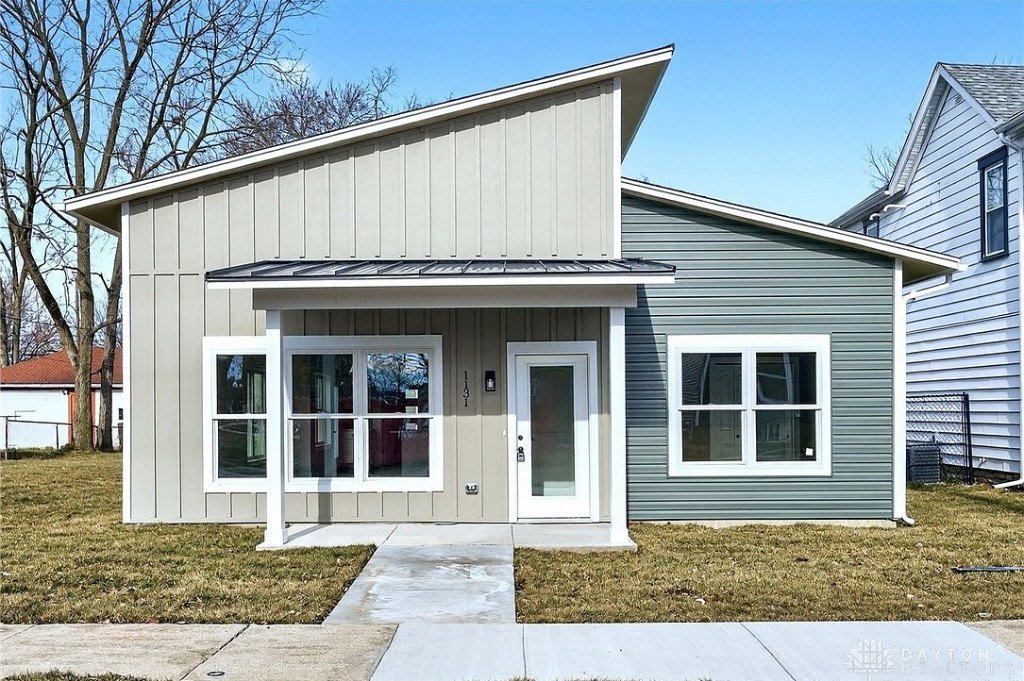
That’s what happened at 1131 W. Second Street in Dayton’s historic Wolf Creek neighborhood, where a newly built four-bedroom home just closed at its full $325,000 asking price. It is one of the strongest comparable sales the neighborhood has on record. It is also something bigger: one of the first completed sales in a wave of new construction that is reshaping the blocks between West First, West Second, North Williams and North Broadway.
To understand why this sale matters, it helps to know what used to sit on the lot.
From Land Bank Parcel to $325,000 Sale
Montgomery County records tell the whole story of this parcel in a handful of lines.
In November 2014, the property transferred out of private ownership and into the Montgomery County Land Reutilization Corporation — the county land bank, the destination for parcels that have run out of road. In May 2015, the city issued a demolition permit and whatever was standing there came down. The lot sat empty. In March 2019, the land bank conveyed it to the City of Dayton.
Then things changed direction. On June 2, 2025, the City of Dayton transferred the parcel to GF Bailey Wolf Creek LLC, the entity behind developer G.F. Bailey’s work in the neighborhood. Building permits had already been issued in December 2024: $154,200 for the dwelling and $102,800 for a detached structure, a combined $257,000 in permitted construction value on a tenth-acre lot the city had been holding.
Eleven years after it went to the land bank, that lot sold as a finished home for $325,000.
That arc — private distress, demolition, land bank, city, developer, new home, market sale — is the exact sequence West Dayton has been trying to complete for a decade. Here it is completed, on the record, in public documents anyone can pull.
What the Buyer Actually Got
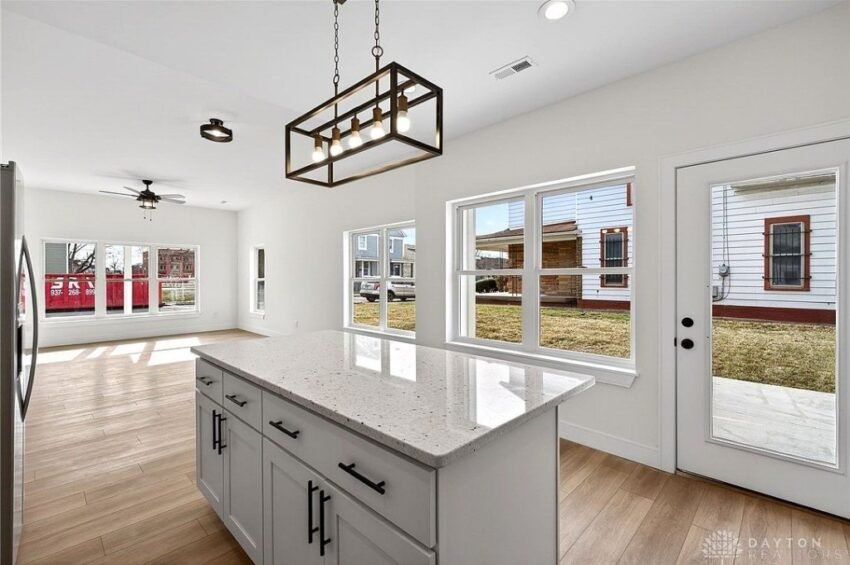
The home is a single-story build with four bedrooms, three full baths and 2,045 square feet, which works out to $159 per square foot. Every bedroom and every bath is on the main level — a layout that quietly does a lot of work, serving first-time buyers, multigenerational households and anyone thinking about aging in place with equal ease.
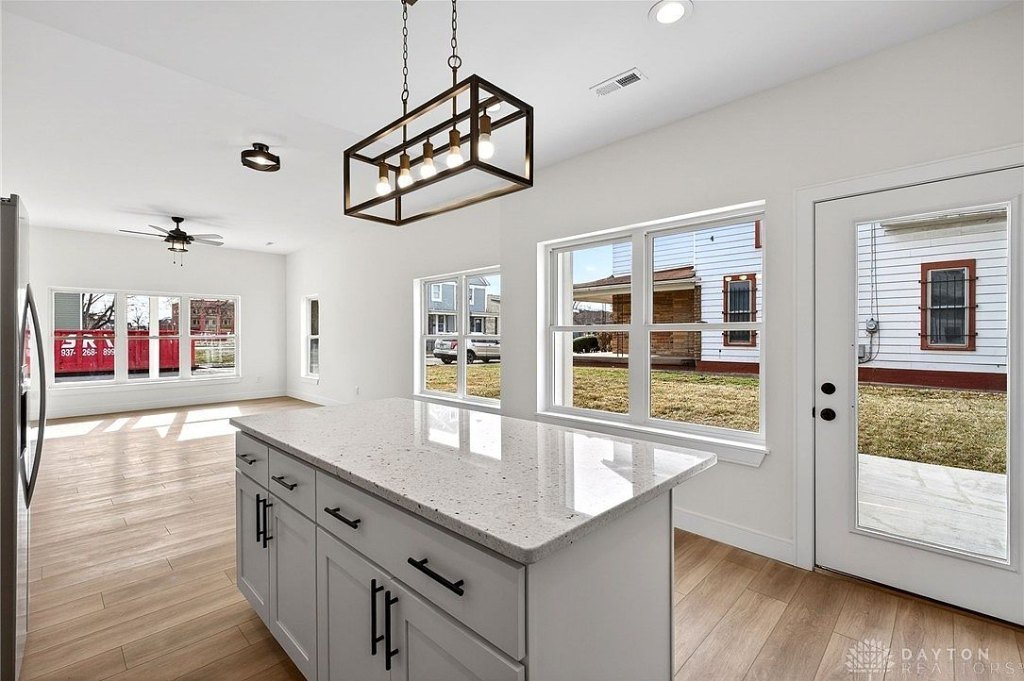
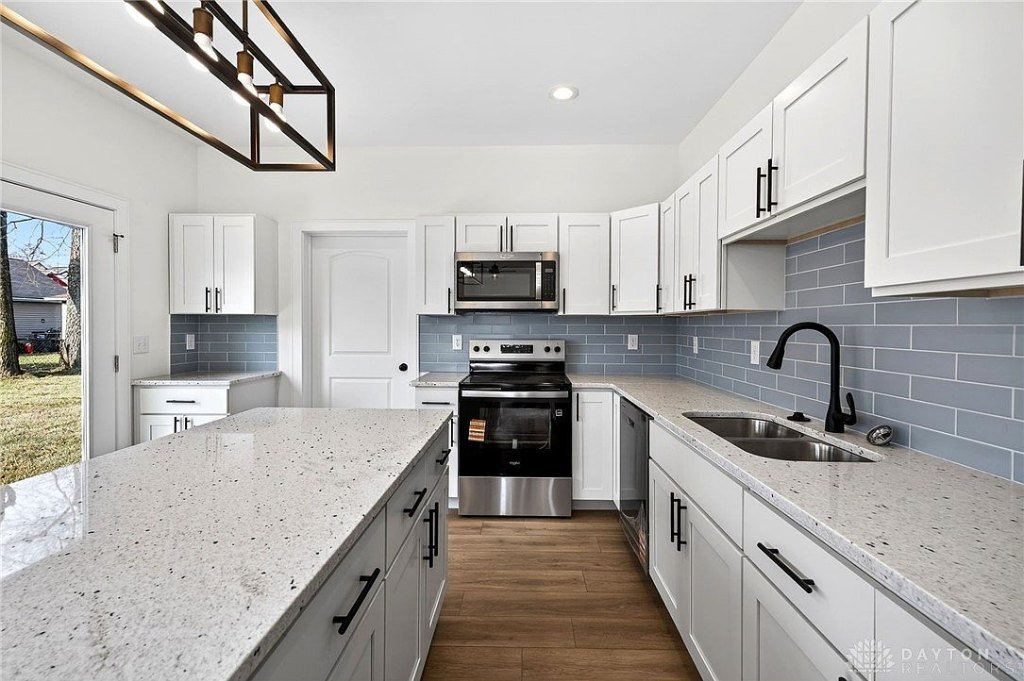
The finish list reads like new construction because it is: granite counters, a kitchen island, stainless appliances, walk-in closets, ceiling fans, central air, a slab foundation and vaulted ceilings throughout the main living space. The living room measures 24 by 19 feet. There’s a covered porch, a patio, and a detached two-car garage — genuinely unusual parking for a historic-grid neighborhood where most homes make do with a pad off the alley.
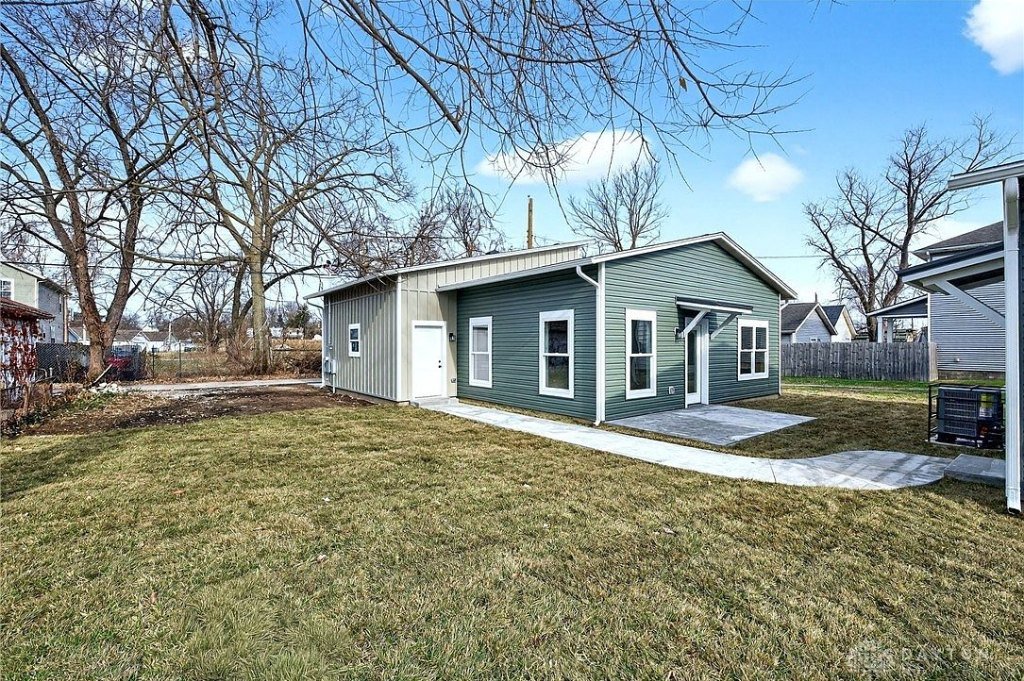
One thing worth naming plainly: this is not a replica of the neighborhood’s Victorians, and it is the better for it. The design is openly contemporary — shed rooflines, board-and-batten and lap siding in sage green and slate blue, oversized windows that pull daylight deep into the floor plan. It reads as new, deliberately.
Set against Wolf Creek’s Queen Annes and American Foursquares, that turns out to be the point. The contrast flatters both. The historic homes read as more distinctive standing next to something plainly modern, and the new build looks designed for this specific block rather than lifted from a subdivision catalog. Neighborhoods that age well are rarely the ones frozen in a single decade — they layer. Wolf Creek just added a very good layer.
The Second Home in the Backyard
The most consequential feature of this property isn’t in the main house at all.
Behind it sits a detached building that contains a two-car garage and, alongside it, a completely separate residence — an accessory dwelling unit, or ADU. Listing photos show it has its own entrance, its own living room, its own full kitchen with a full-size refrigerator, range and dishwasher, its own bedroom and its own full bathroom. It is not a bonus room over a garage. It is a second home, and it conveyed with the sale.
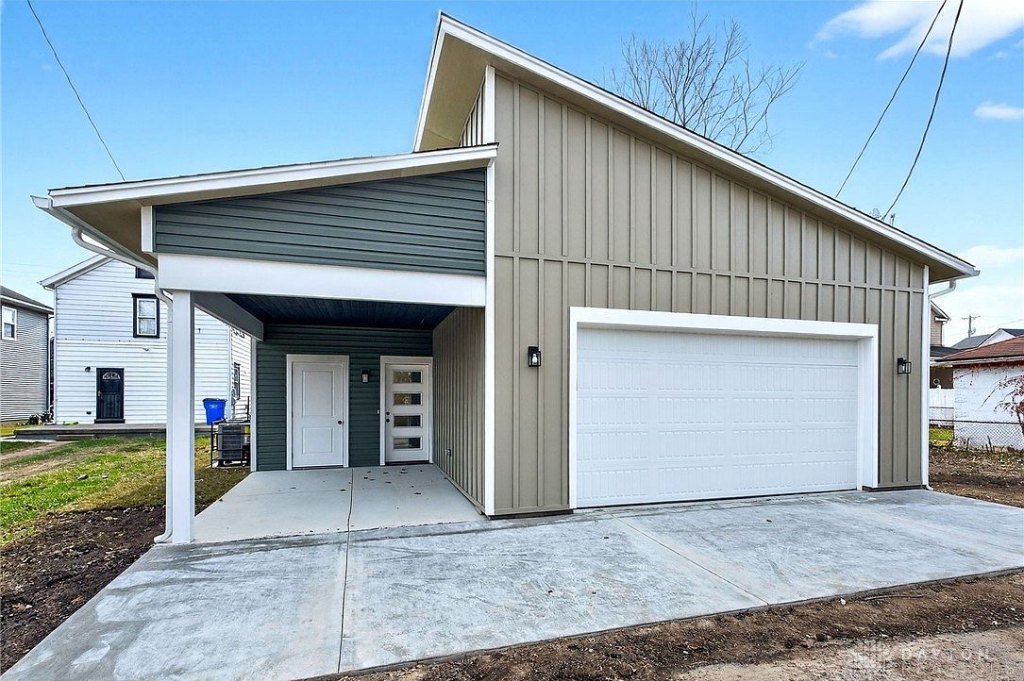
That explains the $102,800 building permit filed as a “detached garage” in December 2024 — a figure far too large for a garage alone, and entirely consistent with a garage plus a finished dwelling.
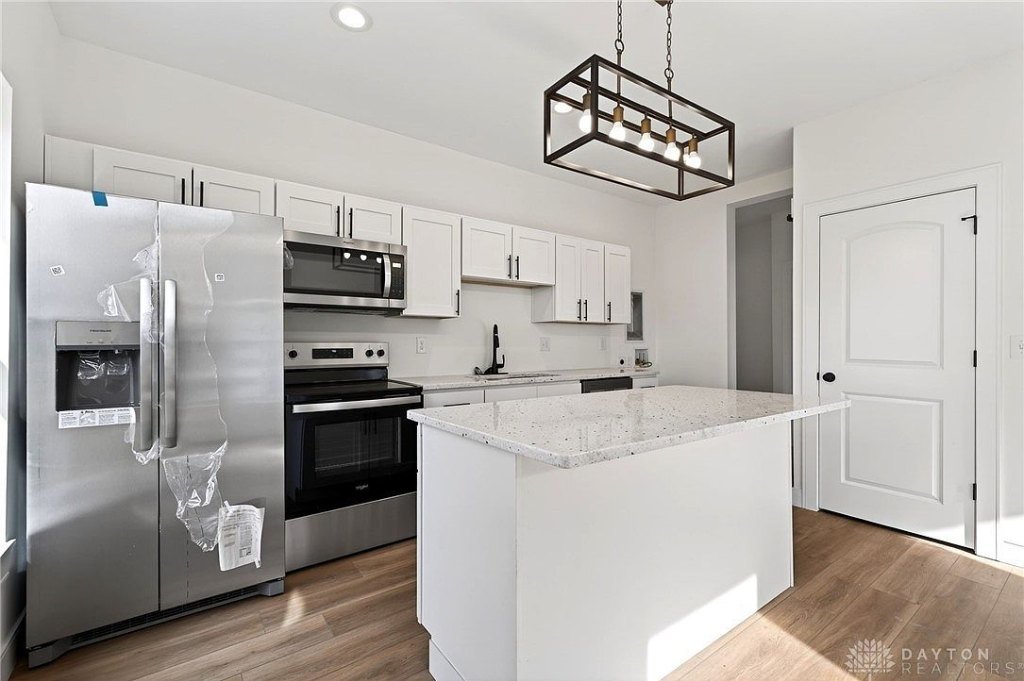
This changes the math for a buyer in a way a bigger house never could. A second unit on the property is a mortgage offset if it’s rented. It’s a landing spot for a parent or an adult child. It’s a home office that isn’t a converted bedroom. G.F. Bailey has been building Wolf Creek homes on this model specifically to test whether the market wants it — and this sale is the answer coming back.
Dayton has been debating accessory dwelling units in policy terms for years. Here is one built, finished, photographed and sold.
A Sale That Resets the Comps
Here is the context that makes $325,000 land the way it does.
The five nearest comparable sales for this home — similar bed count, bath count and square footage — closed at $165,000, $168,000, $170,000, $215,000 and $248,500. Across Wolf Creek as a whole, the median sale price is roughly $100,000, up about 34 percent year over year. Historically the neighborhood’s average sale price has been quoted around $76,000.
Against that backdrop, $325,000 is not an incremental step. It is the top of the range, and it establishes a defensible high comp for every appraiser, lender and builder who looks at this neighborhood next.
It’s also worth noting how it sold. Wolf Creek currently shows roughly 19 active listings and about 19 months of supply — textbook buyer’s-market conditions, where sellers usually give something up. This home gave up nothing. It was listed at $325,000 on January 13, 2026, and it closed at $325,000 on August 20, 2026 — full asking price, after 219 days on the market.
That second number deserves a look. Seven months is a long time to hold a price in a buyer’s market, and most sellers don’t. A cut at day 60 or day 90 would have been the ordinary move, and it would have dragged the comp down with it. Instead the seller waited for a buyer who agreed with the number — and the neighborhood got a cleaner data point because of it.
Automated valuation models had the home at $317,200, with an estimated range topping out near $333,000. The closed price came in above the estimate and inside the top of that band.
A buyer’s market is where soft demand gets exposed. This sale went the other way.
One Sale, a Much Larger Project
The reason this transaction is genuinely news rather than merely notable is that it is early — not late.
Wolf Creek is in the middle of the largest concentrated residential build-out West Dayton has seen in living memory. Roughly 67 new homes are under development or construction in and around the neighborhood, coming from several directions at once:
- G.F. Bailey, the developer here, received a $400,000 agreement approved by the Dayton City Commission on February 21, 2024, supported by Dayton Recovery Plan dollars, to build single-family, owner-occupied homes in Wolf Creek — including the ADU model.
- County Corp, working with the City of Dayton, is delivering market-rate homes through its Wolf Creek Homes program, built by Greater Dayton Construction. Those three-bedroom, two-bath plans run from 1,214 to 1,500 square feet with full basements, priced from $275,000 to $335,000 on West First Street and North Williams Street.
- The city also committed $300,000 in Recovery Plan funding toward a package of roughly 27 to 30 additional single-family homes co-developed with County Corp and Oberer, on scattered sites along West First Street, West Second Street and North Broadway Street.
- The Montgomery County Land Reutilization Corporation is developing nine townhomes on Broadway between First and Second — three buildings of three units each — with an explicit goal of making the Broadway corridor safer for children walking to nearby Edison Elementary.
All of that funding traces back in part to the Dayton Recovery Plan, the city’s deployment of $138 million in federal American Rescue Plan Act dollars.
Put simply: a great deal of public money and private capital has been committed to Wolf Creek on the theory that new homes here would find buyers at prices that make the next home pencil. 1131 W. Second Street is that theory clearing escrow.
The County Corp homes are priced at $275,000 to $335,000. This one closed at $325,000. The comp now exists. The next builder in Wolf Creek is not guessing.
Why Buyers Are Looking at Wolf Creek
For readers outside West Dayton, the appeal is easy to under-appreciate.
Wolf Creek is the birthplace of Paul Laurence Dunbar, and the Paul Laurence Dunbar House — a state memorial and museum — sits within the neighborhood. It borders Wright-Dunbar, home to Dayton Aviation Heritage National Historical Park sites, the Dayton Walk of Fame, restored storefronts and a growing cluster of small businesses. The Wolf Creek Trail runs through it and connects into the Great Miami River Recreational Trail network, one of the largest paved trail systems in the country at more than 90 miles.
And it sits directly across the river from downtown Dayton. Not twenty minutes away — across the river. Walk, bike, drive or take the bus to work, to dinner, to a ballgame. The nearest I-75 ramp is downtown.
That combination — historic architecture, national-register heritage, trail access, genuine walkability to a downtown core — is exactly what buyers pay premiums for in other cities. In Wolf Creek it has been available at a median sale price near $100,000. The gap between what the neighborhood offers and what it costs is the entire investment thesis, and sales like this one are how that gap begins to close.
Recognizing the Professionals Behind the Outcome
Getting a $325,000 new-construction sale done in a 19-month-supply market takes work on both sides of the table.
The listing was carried by Austin R. Castro of Coldwell Banker Heritage, who brought it to market in January and held the line on price for 219 days rather than chase the market down. In a neighborhood where the comp set matters this much, that patience is worth something to every seller who lists in Wolf Creek next. The buyer was represented by Missy Sansabrino of Glasshouse Realty Group, who put a client into a home that will very likely look like a bargain in five years.
Credit is also due to G.F. Bailey for building product at a quality level the neighborhood could support, and to the City of Dayton, the Montgomery County Land Reutilization Corporation and County Corp for the years of unglamorous parcel assembly that made a buildable lot exist at all. None of those steps make headlines individually. Together they produced this one.
More Common Questions About Wolf Creek
Is Wolf Creek a good place to live?
Wolf Creek is a historic neighborhood with seven parks, strong bike infrastructure and transit access, sitting directly across the river from downtown Dayton. The median resident age is about 37, and the neighborhood is walkable with good trail connectivity.
What kind of housing stock is there?
Predominantly Victorian, Craftsman and American Foursquare homes, many of them restoration candidates, now joined by a substantial amount of new construction.
Is this sale price typical for the neighborhood?
No — and that’s the point. The median sale price in Wolf Creek is closer to $100,000, and typical comparable sales in the surrounding area have closed between $165,000 and $250,000. This sale sits well above that range because it’s brand-new construction with a second dwelling unit included.
Is it still possible to buy in at a lower price?
Yes. Wolf Creek currently carries roughly 19 months of supply, which is firmly a buyer’s market, and the median list price across active listings is around $274,900 with plenty below that. Existing homes and renovation projects continue to trade at a fraction of new-construction pricing.
What should a buyer expect over the next few years?
More construction. Between the G.F. Bailey homes, the County Corp and Oberer projects, and the land bank townhomes on Broadway, roughly 67 new homes are in the pipeline. Buyers should expect active job sites, and they should expect the comp set to keep moving.
Why does one sale matter this much?
Because appraisals are built on comparable sales. Until a home in Wolf Creek closed above $300,000, every builder and every lender was working from a comp set that capped out far lower. This sale changes what the next project can be financed against.
As West Dayton keeps building, this is what progress actually looks like in real estate: a lot that had been written off for a decade, a developer willing to build something better than the market had proved it would pay for, and a buyer who showed up and paid it.
The comp exists now. That’s the part that lasts.
Listing data courtesy of Dayton REALTORS® MLS. Property transfer, permit and valuation records courtesy of the Montgomery County Auditor. Information deemed reliable but not guaranteed.